






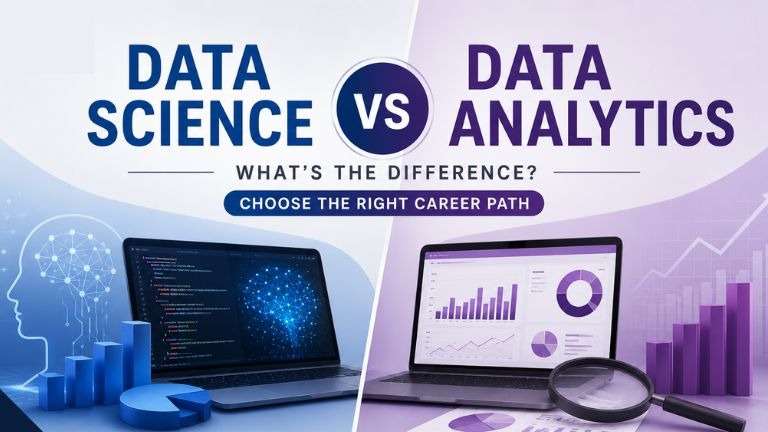
If you’ve been researching career options in technology, chances are you’ve come across two popular terms: Data Science and Data Analytics.
At first glance, they seem almost identical. Both involve working with data, creating reports, and helping businesses make better decisions. Because of this, many students assume they’re the same field.
But here’s the truth:
Data Science and Data Analytics are related, but they are not the same.
Understanding the difference can help you choose the right learning path, save time, and build a career that matches your interests and strengths.
Let’s break it down in simple terms.
Why Do Students Get Confused?
Both Data Scientists and Data Analysts work with data.
Both use tools like Python, SQL, Excel, and visualization software.
Both are in high demand.
Both offer attractive career opportunities.
So what’s different?
The biggest difference lies in what they do with the data.
Think of it this way:
- A Data Analyst explains what happened.
- A Data Scientist predicts what is likely to happen next.
Let’s understand this in more detail.
What is Data Analytics?
Data Analytics is the process of collecting, organizing, cleaning, analyzing, and visualizing data to identify trends and support business decisions.
A Data Analyst takes raw data and transforms it into meaningful information.
For example, imagine an online shopping company notices that sales have dropped this month.
A Data Analyst might answer questions such as:
- Which products sold the least?
- Which cities had fewer orders?
- Which marketing campaign performed best?
- Which customers purchased the most?
The goal is to understand the past and present using data.
What Does a Data Analyst Do?
A Data Analyst typically:
- Collects data from different sources
- Cleans inaccurate or incomplete data
- Creates charts and dashboards
- Writes SQL queries
- Builds reports
- Identifies business trends
- Helps management make informed decisions
Their work focuses on making existing data easy to understand.
Common Tools Used by Data Analysts
Some of the most popular tools include:
- Microsoft Excel
- SQL
- Python
- Power BI
- Tableau
- Google Sheets
These tools help analysts organize data, perform calculations, and create visual reports.
What is Data Science?
Data Science goes a step further.
Instead of only analyzing existing data, Data Scientists build models that can predict future outcomes and automate decision-making.
They combine:
- Programming
- Statistics
- Mathematics
- Machine Learning
- Artificial Intelligence
- Data Analysis
to solve complex business problems.
For example, instead of simply reporting last month’s sales, a Data Scientist might build a model that predicts next month’s sales based on historical trends.
What Does a Data Scientist Do?
A Data Scientist typically:
- Collects large datasets
- Cleans and prepares data
- Performs advanced statistical analysis
- Builds machine learning models
- Creates predictive algorithms
- Automates business decisions
- Develops AI-powered solutions
Their work is more research-oriented and involves solving complex problems.
Common Tools Used by Data Scientists
Data Scientists often work with:
- Python
- R Programming
- SQL
- Pandas
- NumPy
- Scikit-learn
- TensorFlow
- Jupyter Notebook
- Power BI
- Tableau
These tools enable them to analyze data, train machine learning models, and build intelligent applications.
Data Science vs Data Analytics: A Quick Comparison
| Feature | Data Analytics | Data Science |
|---|---|---|
| Main Goal | Analyze past and present data | Predict future outcomes |
| Focus | Reports and insights | Prediction and machine learning |
| Mathematics | Basic to Intermediate | Intermediate to Advanced |
| Programming | Basic Python & SQL | Advanced Python |
| Machine Learning | Usually not required | Core skill |
| Complexity | Beginner-friendly | More advanced |
| Typical Output | Dashboards and reports | Predictive models and AI solutions |
A Simple Real-Life Example
Imagine you own a restaurant.
A Data Analyst would tell you:
- Friday had the highest sales.
- Pizza was the best-selling item.
- Evening orders increased by 20%.
- Most customers ordered online.
These insights help you understand what has already happened.
A Data Scientist would tell you:
- Next Friday’s expected sales.
- Which customers are likely to return.
- Which menu items may become popular next month.
- How weather or festivals might affect demand.
These predictions help you plan for the future.
Which Career is Easier to Start?
If you’re completely new to technology, Data Analytics is generally the easier starting point.
It focuses on:
- Data visualization
- SQL
- Excel
- Reporting
- Business insights
The learning curve is more beginner-friendly, and many entry-level roles are available.
Once you’re comfortable working with data, you can transition into Data Science by learning statistics, machine learning, and AI concepts.
Skills Needed for Data Analytics
A successful Data Analyst should develop skills in:
- Excel
- SQL
- Data Cleaning
- Power BI
- Tableau
- Python Basics
- Communication
- Problem Solving
These skills help turn raw data into actionable business insights.
Skills Needed for Data Science
To become a Data Scientist, you’ll need a broader technical foundation, including:
- Python Programming
- SQL
- Statistics
- Probability
- Machine Learning
- Data Visualization
- Feature Engineering
- Artificial Intelligence
- Critical Thinking
These skills allow you to build predictive models and intelligent systems.
Which Career Pays More?
Both careers offer excellent earning potential.
Generally:
- Data Analysts often begin with entry-level roles focused on reporting, dashboards, and business insights.
- Data Scientists usually command higher salaries because their work involves advanced analytics, predictive modeling, and machine learning.
However, salary depends on several factors, including your skills, experience, industry, location, and the technologies you work with. Building strong practical projects and continuously upgrading your skills can have a significant impact on career growth in either field.
Which Career Should You Choose?
Choose Data Analytics if you:
- Enjoy solving business problems
- Like working with reports and dashboards
- Want to start your career quickly
- Prefer understanding trends and patterns
- Enjoy presenting insights to decision-makers
Choose Data Science if you:
- Love mathematics and statistics
- Enjoy programming
- Want to build AI and machine learning models
- Like solving complex technical problems
- Are interested in predictive analytics and automation
Remember, there isn’t a “better” choice—only the one that best matches your interests and career goals.
Can You Become a Data Scientist After Learning Data Analytics?
Absolutely.
Many professionals begin as Data Analysts because it helps them develop a strong understanding of data, business processes, and visualization.
After gaining experience, they expand their expertise by learning:
- Advanced Python
- Statistics
- Machine Learning
- Artificial Intelligence
- Deep Learning
This progression makes the transition to Data Science much smoother.
Final Thoughts
Choosing between Data Science and Data Analytics doesn’t have to be confusing.
If you enjoy discovering insights, building dashboards, and helping businesses make informed decisions, Data Analytics is an excellent place to start.
If you’re fascinated by artificial intelligence, predictive modeling, and solving complex problems with algorithms, Data Science may be the right path for you.
Whichever direction you choose, one thing is certain—data is shaping the future of every industry. Learning the right skills today can open the door to exciting opportunities tomorrow.
Start Your Learning Journey with SNDC Learning
Whether you’re taking your first step into the world of data or planning a long-term career in analytics and AI, structured learning makes all the difference.
Explore industry-focused programs, hands-on projects, and expert-led training with SNDC Learning to build practical skills and prepare for real-world careers.
Your future in data starts with the right foundation.